Source uv resistant artificial olive tree for Hotel Cafe Wedding
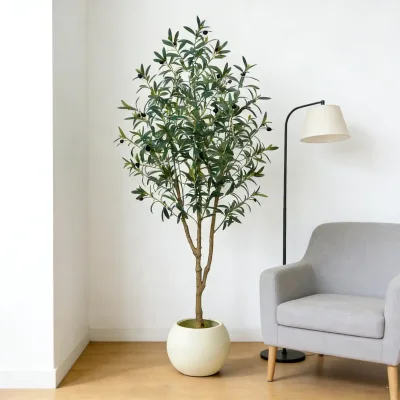
Compare 30 listings for the uv resistant artificial olive tree suitable for indoor and outdoor decoration. Buyers can evaluate options with varying heights, materials like metal or plastic, and customization features for hotels, cafes, and events.
Key considerations
Products List




Comprehensive Sourcing Guide
Strategic Sourcing Guide for UV Resistant Artificial Olive Trees
Procuring artificial olive trees for commercial and residential environments requires a nuanced understanding of material science, manufacturing processes, and supply chain logistics. The core keyword "UV resistant artificial olive tree" points to a specific segment of the artificial foliage market designed to withstand environmental stressors while maintaining aesthetic integrity. Buyers must navigate a landscape where product attributes vary significantly between suppliers, often mixing metal, plastic, and handmade components. This guide provides a disciplined framework for evaluating potential suppliers and products based on verified facts and industry standards, ensuring that procurement decisions are grounded in observable data rather than marketing assertions.
Technical Specifications and Material Composition
The foundational element of any artificial olive tree is its material composition, which directly dictates its durability and resistance to environmental factors. In the current market, products are frequently constructed using a combination of materials to achieve structural stability and visual realism. Observed specifications indicate that the primary structural components, such as the trunk and base, often utilize metal or plastic. The metal variants provide a robust framework capable of supporting significant height, while plastic components are frequently employed for the foliage to simulate the texture of real leaves.
A critical technical distinction lies in the leaf composition. The supplied data highlights that suppliers offer "Banyan Leaves or Olive Leaves," suggesting that the specific botanical simulation is a customizable variable. For UV resistance, the polymer formulation of the plastic leaves is paramount. While the provided facts do not list specific UV-stabilization percentages or chemical additives, the attribute "UV Resistant" implies a formulation designed to prevent fading and brittleness under sunlight exposure. Buyers should verify that the plastic used for the leaves is explicitly rated for outdoor conditions, as indoor-grade plastics will degrade rapidly when exposed to direct sunlight.
The structural design also plays a vital role in longevity. The "Shape" is often described as "as Photo," indicating that the tree's silhouette is customizable to match specific design requirements. The "Base" is available in "Square or Round Shape," which must be compatible with the intended installation surface. Furthermore, the "Trunk Color" supports customization, allowing buyers to match the tree to existing architectural elements. The processing method is a hybrid of "Machinery+Handmade" or "Hand-Made," which suggests that while the initial shaping may be automated, the final assembly and leaf placement involve manual labor to ensure high simulation quality. This manual intervention is crucial for achieving the "High Simulation" advantage noted in product descriptions, ensuring that the artificial tree does not appear rigid or unnatural.
Compliance, Certification, and Safety Standards
When sourcing artificial trees for public or commercial use, compliance with safety and environmental standards is non-negotiable. The supplied product facts reveal a complex compliance landscape. One specific observation notes that the product is "Non-fire Retardant," which is a critical red flag for indoor applications in public spaces such as hotels, cafes, and shopping malls. Buyers must immediately verify if the specific batch or model they are considering has been treated with fire-retardant chemicals, as many jurisdictions mandate fire resistance ratings for commercial decor. The absence of this attribute in the general description necessitates a direct inquiry to the supplier regarding fire safety certifications.
Regarding environmental standards, the data mentions "Sustainable Material Packaging" and "Non Power" operation, which are positive indicators for energy efficiency and waste reduction. However, the "Fire Resistance" attribute being listed as "Non-fire Retardant" suggests that the base product may not meet strict fire codes without additional treatment. Buyers should request documentation proving compliance with local fire safety regulations, such as NFPA standards in the United States or EN 13501 in Europe, before finalizing a purchase.
Additionally, the "Standard" attribute is listed as "customized" or specific height/size configurations like "90cm, 120cm, 150cm." This implies that there may not be a single universal standard governing all units. Instead, buyers must define their own technical standards for height, size, and shape, ensuring the supplier adheres to these custom specifications. The "prod_standard" being "customized" means that quality control must be rigorous, as there is no default industry standard to fall back on for every unit produced.
Cost Drivers and Pricing Dynamics
The pricing for artificial olive trees is influenced by several distinct factors, ranging from material costs to the complexity of customization. The observed price range in the market spans from $5.2 to $980 USD, a significant variance that reflects differences in size, material quality, and manufacturing effort. The lower end of the spectrum likely corresponds to smaller, mass-produced units with standard dimensions, while the higher end represents large, custom-designed trees with premium materials and extensive hand-finishing.
A primary cost driver is the level of customization. The "Customization" attribute is marked as "Available," and the "Standard" is often "customized height/Size/Shape." Custom orders require additional engineering, pattern creation, and manual labor, which inevitably increases the unit cost. The "MOQ" (Minimum Order Quantity) also plays a crucial role in pricing. The observed MOQ range is 1 to 300 units, with specific instances noting an MOQ of 12 PCS. Smaller orders may incur a higher per-unit cost due to setup fees and the inefficiency of small-batch production. Conversely, larger orders benefit from economies of scale, potentially lowering the price per unit.
Another significant cost factor is the packaging and shipping method. The "prod_packing" varies from "Bubble Wrap with Wood Frame or Carton" to "Plywood/Iron Frame/Carton." Heavy-duty packaging, such as plywood frames, is essential for protecting large trees during transit but adds substantial weight and volume, increasing shipping costs. The "Shipping" options include "by Express/by Air/by Sea/by Train," each with different cost implications. For large, heavy trees, sea freight is typically the most economical option, though it extends the lead time. Buyers must factor in these logistics costs when calculating the total landed cost of the product.
Typical Applications and Usage Scenarios
Artificial olive trees are versatile decor elements suitable for a wide array of environments. The "Application" attributes list "Indoor,Outdoor," "Shopping Mall, Outdoor, Home, Building," and "Hotel, Shop, Restaurant." This broad applicability underscores the need for buyers to select the correct product variant for their specific use case. For outdoor applications, the "UV Resistant" claim is critical, as these trees will be exposed to direct sunlight, rain, and temperature fluctuations. The "Suitable for: Public" attribute further reinforces their use in high-traffic areas where durability is essential.
The "Occasion" list includes "Wedding, Event, Opening, Hotel, Cafe Decoration," indicating that these trees are often used for temporary or semi-permanent installations. In these scenarios, the "Easy Installation" advantage is a key selling point. The "Life Time" is estimated at 5-8 years, which suggests that while they are durable, they are not intended to be permanent fixtures like real trees. Buyers should consider the expected lifespan when budgeting for replacement or maintenance.
The "Usage" is primarily "Decoration," but the specific context matters. In a hotel lobby, the tree may serve as a focal point requiring high aesthetic quality and fire resistance. In a home setting, the focus might be on size and style compatibility. The "Style" is defined as "Artificial Tree," and the "Color" is often "Multicolour" or "Multicolour," allowing for customization to match interior design themes. The "Leaves" can be "Banyan Leaves or Olive Leaves," offering flexibility in the botanical look.
Supplier Evaluation and Verification
Evaluating suppliers for artificial olive trees requires a rigorous approach to verify claims and ensure reliability. The "prod_origin" is listed as "China," which is a common manufacturing hub for this product category. However, the origin alone does not guarantee quality. Buyers should assess the supplier's production capabilities, specifically their ability to handle "Machinery+Hand-Made" processes. The balance between automation and manual labor is crucial for achieving the "High Quality with Best Price" advantage.
Key verification steps include checking the "Produce Time," which is listed as 7-15 days. This lead time is relatively short, suggesting efficient production cycles. However, buyers must confirm if this timeline includes the time for customization and packaging. The "Sample Lead Time" is noted as 7 days, which is a useful benchmark for evaluating the speed of prototype delivery. Suppliers who can deliver samples quickly are often more responsive and capable of handling urgent orders.
The "Advantage" attributes, such as "High Simulation, Easy Installation, No Pollution," should be treated as observations rather than guaranteed claims. Buyers must physically inspect samples to verify the "High Simulation" claim, checking for realistic leaf texture and color variation. The "No Pollution" claim likely refers to the lack of maintenance requirements (no watering, no pruning), but buyers should verify that the materials used are non-toxic, especially for indoor applications.
Quality Control and Long-Term Procurement Considerations
Quality control is essential to ensure that the artificial olive trees meet the buyer's expectations over their intended lifespan. The "Life Time" of 5-8 years implies that the materials must withstand wear and tear. For outdoor use, the "UV Resistant" quality must be tested to ensure that the leaves do not fade or become brittle after prolonged sun exposure. Buyers should request test results or certifications related to UV stability, as the supplied facts do not provide specific test data.
The "Packaging" is a critical aspect of quality control during transit. The "prod_packing" options include "Bubble Wrap with Wood Frame or Carton" and "Plywood/Iron Frame/Carton." For large trees, the wooden or iron frame is necessary to prevent damage during shipping. Buyers should verify that the packaging is robust enough to protect the tree from impacts and moisture. The "Sustainable Material Packaging" attribute is a positive sign, indicating an environmental consideration, but it should not compromise the protective qualities of the packaging.
Long-term procurement considerations involve the scalability of the supply chain. The "MOQ" range of 1 to 300 units allows for flexibility, but buyers should plan for future orders to secure better pricing. The "Customized" nature of the product means that once a design is approved, it can be replicated for future orders, reducing the need for repeated sampling. However, buyers must ensure that the supplier maintains consistency in the "Hand-Made" process, as manual labor can introduce variability. Establishing a long-term relationship with a supplier who understands the specific customization requirements is key to maintaining quality over time.
Final Procurement Checklist
To summarize, sourcing UV resistant artificial olive trees requires a meticulous approach to technical specifications, compliance, and supplier evaluation. Buyers must verify the material composition, ensuring that the plastic leaves are UV-stabilized and the metal or plastic trunk is robust. Compliance with fire safety standards is critical, especially for public spaces, and the "Non-fire Retardant" attribute in general descriptions necessitates specific confirmation. Cost drivers such as customization, packaging, and shipping must be factored into the total budget.
The table below summarizes the key attributes and verification points for buyers:
| Attribute | Observed Value | Verification Requirement |
|---|---|---|
| Material | Metal, Plastic | Confirm UV-stabilized plastic for leaves; check metal grade for trunk. |
| Fire Resistance | Non-fire Retardant | Request fire safety certification for specific models. |
| Production Time | 7-15 Days | Confirm if this includes customization and packaging. |
| Sample Lead Time | 7 Days | Verify speed of prototype delivery. |
| Packaging | Bubble Wrap, Wood Frame, Carton | Ensure packaging is robust for transit and sustainable. |
| Customization | Available | Define exact height, size, shape, and leaf type requirements. |
| Life Time | 5-8 Year | Plan for replacement schedule based on usage intensity. |
| Origin | China | Verify supplier credentials and production capacity. |
By adhering to these guidelines and focusing on verified facts, buyers can make informed decisions that balance cost, quality, and performance. The goal is to secure artificial olive trees that not only meet aesthetic requirements but also withstand the rigors of their intended environment, providing long-term value and visual appeal.
FAQs
Can I customize the size and shape of the tree?
Yes, customization for height, size, and shape is available for this product. Buyers can specify dimensions like 90cm, 120cm, or 150cm to match their design needs while ensuring the trunk color and base shape align with the installation surface.
What is the typical production lead time for orders?
The standard producing time ranges from 7 to 15 days for most orders. Sample lead times are typically 7 days, allowing buyers to verify quality before committing to larger batches, though this may vary based on the complexity of customization.
How long does the artificial olive tree typically last?
The expected life time for these artificial trees is between 5 and 8 years. This duration depends on usage conditions, with outdoor models requiring UV-resistant materials to maintain color and structural integrity against environmental exposure.
What materials are used for the trunk and leaves?
The product utilizes metal or plastic for structural components like the trunk and base. Leaves are available as Banyan or Olive types, often crafted using a combination of machinery and handmade processes to achieve high simulation and realistic texture.
Is the product suitable for outdoor public spaces?
Yes, the product is suitable for public indoor and outdoor applications such as hotels, shopping malls, and cafes. However, buyers must verify fire resistance ratings as the standard listing indicates non-fire retardant properties, which may require special treatment for public compliance.
What packaging options are available for shipping?
Packaging options include bubble wrap with wood frames, plywood or iron frames, and cartons to ensure safe transit. Sustainable material packaging is also available, protecting the tree from damage while adhering to environmental considerations during international shipping.